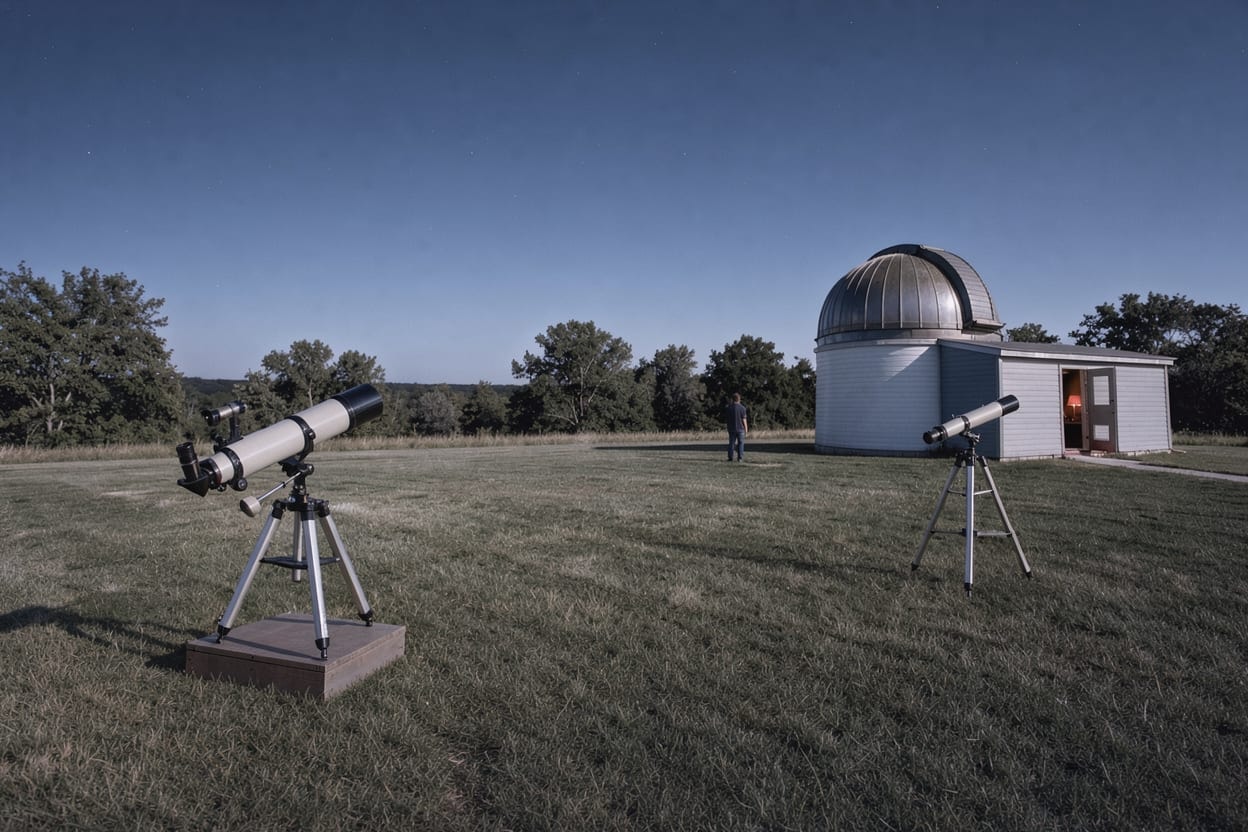
An open lawn in northern Illinois
The patch of grass outside Lockwood Park Observatory is a good place to explain amateur astronomy. The scope inside the dome gives a close look at a bright object. Portable instruments out on the lawn take in other fields. In the auditorium, a talk can continue the conversation after everyone has stepped away from the optics. A reader who has never been to Rockford can try the same progression in a backyard, from a broad look overhead to a single feature on the Moon.
The Observing Lawn covers those different ways of looking. The field pages help with the first ten minutes outdoors. The gallery names the subjects local observers photographed and the instruments they used. The history follows people who made glass into telescopes and found ways to share them with neighbors.
The people and the place
Rockford Amateur Astronomers was founded in 1958. The group operates Lockwood Park Observatory in cooperation with the Rockford Park District. Its main nighttime telescope is a ten-inch refractor, and its public program has long included portable telescopes, binoculars and astronomy talks. The club belongs to the Astronomical League and is listed in the Night Sky Network. Lockwood Park Observatory · Night Sky Network club listing
The name on this publication is The Observing Lawn. It is independent of Rockford Amateur Astronomers, Lockwood Park Observatory, the Rockford Park District and the other organizations described here. The club and park manage their own public nights, meetings, group arrangements and membership. For operating information use the park’s observatory page. Park information for visitors
How to use the pages
If you have one clear hour, start with the Moon, a bright planet or a cluster wide enough for binoculars. If the night is cloudy, a paper chart, a mirror maker’s story or a comparison of old camera techniques can be a good use of the same hour. Pages about the local schedule point back to the operator. Astronomical forecasts link to the chart maker, and solar viewing instructions point to NASA’s safety information.
The field studies show what to look for in a type of instrument, object or setting. Historical accounts identify the photographers and equipment where these are known. A telescope view depends on aperture, the air and the time someone spends at the eyepiece. One of the best reasons to keep a notebook is to find out which of those mattered on your own evening. Start with a first night outside