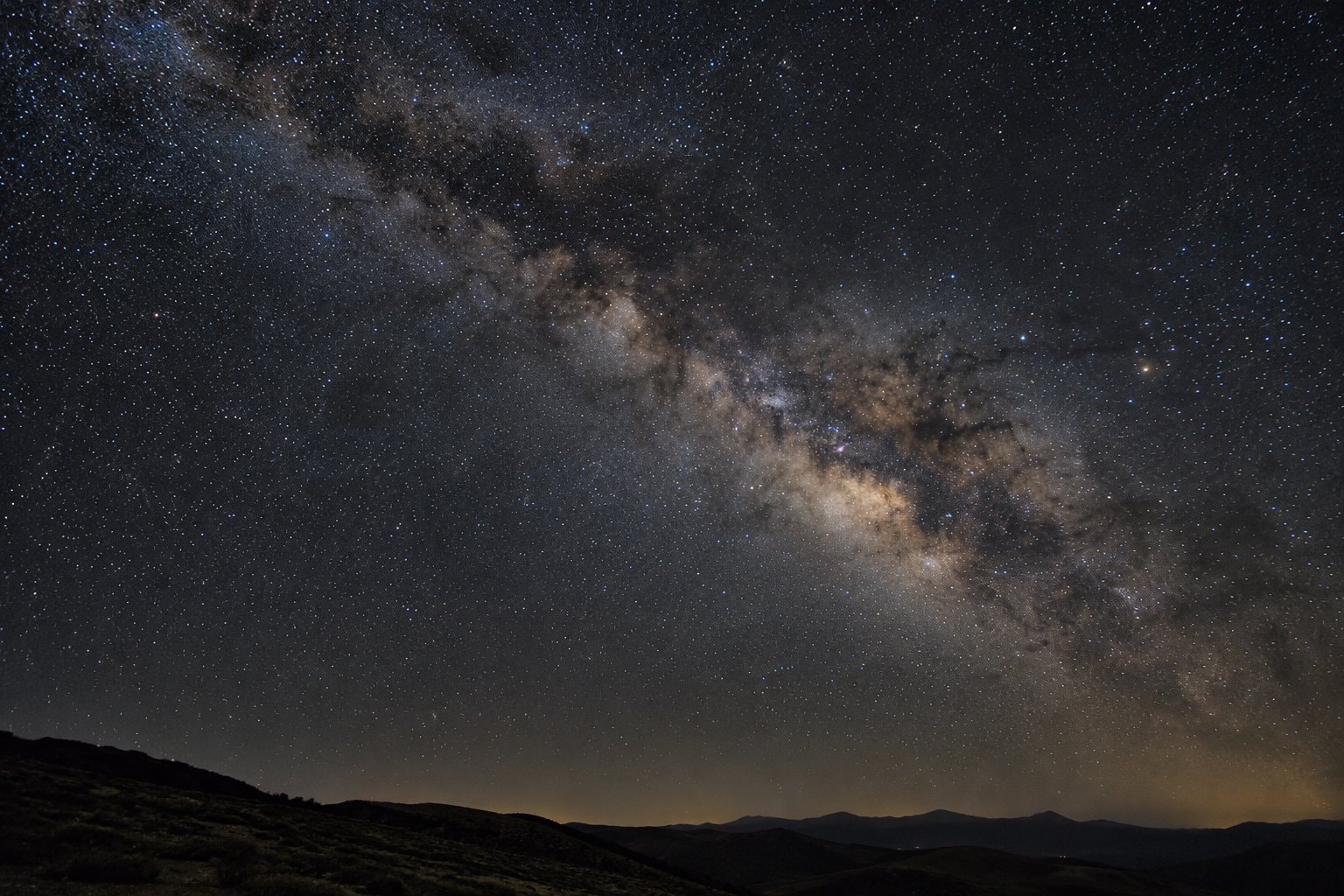
Deep-sky observing means looking beyond the familiar discs of the Moon and planets toward nebulae, star clusters and galaxies. These targets ask different questions of the observer. Is the light concentrated or spread out? Does a patch keep its shape when you look again? Is a dark region part of the object or simply the space between bright stars? Begin with a modest expectation and let the view establish what is possible.
Wikipedia’s astrophotography article explains that long exposures accumulate light over time and can record faint objects that the eye cannot see. An eyepiece view and a photograph therefore answer different questions. Give the visual scene its own description before studying a detailed image. The Messier list supplies a useful framework for learning many of these objects, while the observing conditions determine how much of their appearance is available on a particular night.
Wikipedia’s averted-vision article describes looking slightly beside a faint target while keeping attention on it, a technique discussed in observing literature with relatively little rigorous measurement. The page on night vision at the eyepiece explains how ordinary observing practice fits the eye’s changing response to darkness. Try a relaxed look, compare direct and slightly averted views, and avoid declaring a feature certain merely because a photograph suggests where it should be.
The Crab Nebula
Wikipedia identifies the Crab Nebula as a supernova remnant in Taurus. Its article describes an oval mass of filaments around a diffuse central region. For a modest telescope, begin with the question of whether a faint, extended patch can be distinguished from the surrounding field. Use the chart to confirm the field before searching for a shape. A long-exposure photograph can make the filament structure a subject of study, but that is a different standard from simply noticing the nebula at the eyepiece. A brief, uncertain glimpse belongs in the notes with its uncertainty intact. A convincing faint glow is already an observation worth comparing on a darker night.
The Dumbbell Nebula
Wikipedia describes the Dumbbell Nebula as a planetary nebula surrounding a white dwarf in Vulpecula. The article notes that it is visible in binoculars and is a popular target for amateur telescopes. The name is a useful memory aid, but do not force the first view into a familiar outline. Begin by separating the extended glow from the surrounding stars, then ask whether its brightness varies across the patch. A modest telescope’s view may support a broad shape before any finer structure becomes convincing. Long-exposure photographs allow closer study of the nebula’s outline and internal detail; they do not set a minimum achievement for a visual session. Keep the eyepiece notes tied to the glow and structure actually seen.
The Triangulum Galaxy
The Triangulum Galaxy is a spiral galaxy in the constellation Triangulum, as described by Wikipedia. The article stresses its diffuse, extended appearance, including for dark-adapted naked-eye viewers under suitable conditions. Treat this as a search for light spread across an area of sky. A modest telescope’s narrow view can make it easy to examine the wrong scale: keep room around the suspected glow and compare it with the neighbouring background. Long-exposure photographs offer a way to study spiral structure after the visual session, but a photograph’s obvious outline need not be obvious in the eyepiece. If the field looks empty, check the chart and the conditions rather than treating the absence of a striking image as a definite absence of the galaxy.
The Pleiades
Wikipedia places the Pleiades, an open star cluster readily visible to the naked eye, in the northwestern part of Taurus. Begin with the naked-eye pattern, then use binoculars or a wide telescope view to compare the arrangement of bright points and fainter companions. Leave enough surrounding sky for the cluster to look like a connected scene. Its account identifies reflection nebulosity as dust reflecting light from the cluster’s bright stars and notes the value of long-exposure photographs for showing it. At the eyepiece, the stars are a sensible first task; treat possible haziness around them cautiously. Long-exposure photographs make the dust a more accessible subject, while a modest visual instrument gives a direct sense of the cluster’s pattern and its place against the surrounding sky.
The Lagoon Nebula
Wikipedia identifies the Lagoon Nebula as a large emission nebula in Sagittarius. The article explicitly contrasts its pink appearance in long-exposure photographs with the generally grey view through binoculars or a telescope. That comparison is a useful guide to expectations: a grey patch can be a faithful view of a colourful photographic subject. In a modest telescope, look for a broad glow and the relation between it and the stars within the field. A clear southern horizon matters to a search in Sagittarius from northern Illinois. Keep the view wide while locating the scene, then decide whether closer inspection gives a more settled outline. Record shape and contrast rather than waiting for a photographic colour to appear.
The Orion Nebula
The Orion Nebula lies below Orion’s Belt in the constellation’s sword, and Wikipedia notes that its nebulosity is obvious in binoculars or a small telescope. The article describes it as a region where stars and planetary systems form within clouds of gas and dust. Start with the sword as a whole, then study the hazy part and the stars within it. A modest telescope can make the difference between starlight and an extended glow a concrete observing lesson. Long-exposure photographs provide a much richer view of the cloud’s extent and structure; allow them to explain the object without replacing the visual description. Check which edges are clear and which merge gradually with the surrounding field. Repeated looking is more useful than naming every faint curve.
Stephan’s Quintet
Wikipedia describes Stephan’s Quintet as a visual group of five galaxies in Pegasus, of which four form a physical association. Its compact grouping makes photographs valuable for understanding how separate galaxies occupy a crowded field. For a modest visual instrument, treat it as a demanding search rather than expecting the photographic arrangement to announce itself. Confirm the surrounding stars carefully and keep any suspected faint patches distinct from confident detections. Long-exposure photographs can make the individual galaxies and their relationships far easier to study than an uncertain eyepiece view. A page about a showpiece can still include a challenging object: recognising the limits of a particular session is part of learning the sky.
The Horsehead Nebula
Wikipedia places the Horsehead Nebula, a dark nebula, just south of the easternmost star in Orion’s Belt. The article explains that thick dust blocks light from behind it, while colour images show glowing hydrogen gas in the background. This is a different visual problem from finding a bright patch: the object is a dark shape against a faintly glowing background. A modest telescope should not be expected to reproduce the recognisable photographic outline. Treat the object primarily as a subject for learning how dust and background light make a scene. Long-exposure photographs reveal the relationship between the silhouette and the surrounding glow. At the eyepiece, careful field identification and an honest account of what remains unseen are useful outcomes too.
The Double Cluster
According to Wikipedia’s Double Cluster article, this view contains neighbouring open clusters in Perseus that are visible to the naked eye. Use a broad view to see the neighbouring concentrations together, then compare the brighter patterns with the less crowded sky around them. A modest telescope offers a scene built from individual points rather than an uncertain diffuse glow, making this a helpful change of pace between faint targets. Long-exposure photographs can show additional faint stars and make subtle colour differences easier to inspect. The visual reward is the arrangement itself: compare how the concentrations look within a shared field and how that impression changes when you examine them more closely.
A spiral galaxy in Pegasus
Wikipedia identifies NGC 7331 as an unbarred spiral galaxy in Pegasus. Its article notes that visible-light and infrared photographs show a slightly off-centre core, with the disc extending farther on a side. In a modest telescope, begin with a more limited task: check for an elongated glow and a possible brighter central region, noting which impressions persist. The photographic asymmetry is a reason for careful later comparison, not an outline to copy into a visual sketch. Long-exposure photographs allow the disc to be examined far beyond a tentative visual impression. Keeping separate notes for the eyepiece view and the image makes the comparison clearer and avoids turning uncertain detail into a confident claim.
The Andromeda Galaxy
The Andromeda Galaxy is a barred spiral galaxy in Andromeda and the nearest major galaxy to the Milky Way, according to Wikipedia. The article notes that it is visible to the naked eye in dark skies. Start with a broad search before studying the brighter central glow through binoculars or a modest telescope. Give the surrounding sky enough space in the view, and ask how far the faint light can be followed with confidence. Long-exposure photographs reveal an extensive galaxy with structure that a casual glance cannot take in. The visual session has a simpler question: where does the glow seem to fade into the background, and does that impression hold when you look again?
Use photographs as another kind of evidence
NASA’s Hubble Messier catalog offers detailed photographs and explains how observations at different wavelengths are combined, sometimes using assigned colours to make information visible. This is a useful reminder that an astronomical photograph is a measured and processed view of light, not simply an enlarged eyepiece scene. The guide to backyard astrophotography develops that distinction. Leave the notebook’s visual account unchanged when a detailed image supplies additional information: the comparison becomes more interesting when each view keeps its own limits.