Never look at the Sun through binoculars, a telescope, a camera or a phone unless a proper solar filter made for that purpose covers the front of the instrument, and never look with the naked eye except through eclipse glasses or viewers meeting the safety standard described by NASA’s eclipse-safety guidance.
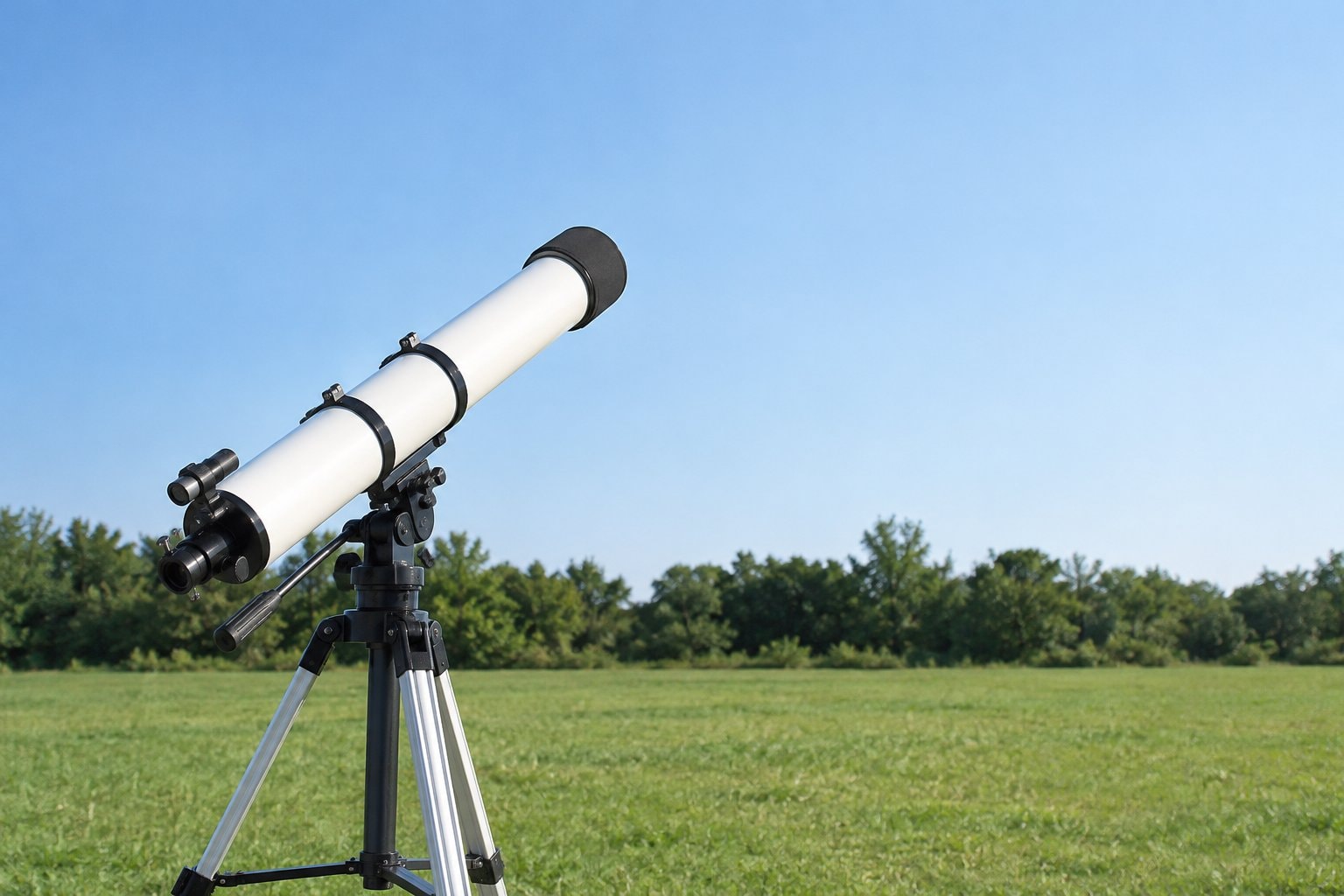
Solar observing begins with that boundary. Daylight, a familiar bright sky and a seemingly ordinary telescope do not make direct viewing an ordinary observing task. Set the equipment and viewing method before any instrument is pointed toward the Sun. If the suitability or condition of the solar equipment is uncertain, keep the instrument away from the Sun and use a different observing subject.
A nearby star, studied in different light
NASA’s Sun overview describes the Sun as the star at the centre of the solar system, whose gravity holds the system together. Wikipedia’s solar-observation article describes the study of the Sun’s behaviour and its relationship with Earth and the rest of the solar system. For a backyard observer, the interest is in a changing subject: dark markings on the visible disc, structures shown by specialised solar equipment and the geometry of an eclipse. These are different kinds of view, with different equipment requirements. A familiar name for a filter does not make all filters interchangeable.
Keep the question for a session specific. A properly prepared white-light view might be used to note the broad position and shape of dark spots. A suitable hydrogen-alpha system opens a different view of the Sun’s atmosphere. Start from what the intended equipment is designed to show, rather than expecting every solar feature to be available through any solar filter.
The front of the instrument matters
NASA’s safety guidance says that instrument filters must be attached to the front of the optics and that eclipse glasses or handheld viewers must not be used as substitutes with cameras, binoculars or telescopes. Keep the distinction between eye-only viewers and instrument filters clear. An eye-only viewer belongs to its intended direct-viewing use; an optical instrument needs the appropriate solar arrangement over its Sun-facing end. Do not treat an eyepiece accessory or a dark-looking material as adequate merely because the image seems less bright.
NASA also distinguishes eclipse glasses from ordinary sunglasses, which are not safe for direct solar viewing. Its guidance also says to inspect solar glasses and handheld viewers and discard damaged ones. Those checks concern purpose-made viewing equipment, not an improvised filter test. A solar session should have a known method before it begins, with instructions for that method understood and the arrangement secure.
Comfort and a clear setup matter at the telescope. Arrange a stable place for the instrument and keep attention on the viewing method rather than changing several things while pointing toward the Sun. A casual search with unprepared binoculars is not part of safe solar practice. The beginner’s guide places the same safety boundary beside ordinary night-sky observing.
White light and sunspots
Wikipedia’s astronomical-filter article describes white-light solar filters as front-mounted filters through which features such as sunspots and surface granulation can be viewed. This is a view suited to examining the Sun’s visible disc rather than assuming a dramatic display around its edge. Begin by locating any dark regions, then compare their positions and outlines. A simple drawing can distinguish a broad group from an isolated marking without claiming more detail than the image supports.
Wikipedia’s sunspot article describes temporary, darker surface regions associated with concentrated magnetic fields and a lower temperature than their surroundings. A dark spot is therefore not a hole in the Sun or a small object floating in front of it. The explanation belongs to the Sun’s own surface activity. Separate that physical account from the visual notes: a drawing records the shape in view, while the source explains the kind of feature being studied.
Its account explains that the abundance of sunspots varies with the solar cycle, and that spots can expand, contract and eventually disappear. Repeat views can therefore ask whether a familiar group’s outline or position has changed. Leave the earlier sketch as it was made and compare the views directly. An apparently blank disc can also be a meaningful record of the session, without implying that the Sun as a whole is inactive or unchanging.
Hydrogen-alpha shows another subject
Wikipedia’s hydrogen-alpha article describes H-alpha as a deep-red spectral line whose solar applications include viewing prominences and the chromosphere. This is a view selected by a narrow range of light, rather than simply a white-light view with its brightness turned down. Terms such as prominence and chromosphere refer to features and layers in the solar atmosphere, and a suitable system is designed around that different subject.
The astronomical-filter article distinguishes the narrow H-alpha filters used for solar viewing from filters used for nighttime nebula photography. That distinction is a reason to rely on the intended solar equipment and its instructions, never a reason to assemble a substitute from familiar nighttime accessories. The page on the observer’s eyes and body discusses solar and laser hazards alongside ordinary night observing. It does not turn solar equipment choices into a general eye-care practice.
Eclipses are about position as well as appearance
A total eclipse and a partial eclipse are not interchangeable experiences. Wikipedia’s solar-eclipse account explains that totality occupies a limited path, while a partial view extends across a wider surrounding region. The path tells you where the Moon’s apparent position fully covers the bright face of the Sun, not simply where an eclipse is noticeable.
Wikipedia’s account of the April 8, 2024, total solar eclipse says its path crossed southern Illinois and intersected the August 21, 2017, total-eclipse path near Carbondale. NASA’s page about that eclipse also traces its path through Illinois and explains that totality belongs to the region where the Moon completely covers the Sun’s bright face. The historic crossing is an example of eclipse geometry; it is not a schedule for another event or a description of a local observing session. The guide to the year in the sky puts eclipses beside other changing sights without listing future event dates.
A case series published in 2018 by Ricks and colleagues reported eye injuries in Utah after the August 2017 eclipse, with the abstract noting that charts were available for only some of the cases with examination findings. The report concerns a limited set of reported cases, not a measurement of every eclipse viewer’s experience. It belongs beside the safety guidance as evidence that looking toward an eclipse can have consequences when the viewing method is unsuitable.
Carry the ordinary discipline of observing into a solar session: a clear purpose, a settled instrument and notes that distinguish a firm view from a brief impression. The additional requirement is the appropriate solar viewing method from the outset. A worthwhile solar observation can remain simple, with the Sun’s changing markings recorded carefully and the safety boundary kept explicit throughout.