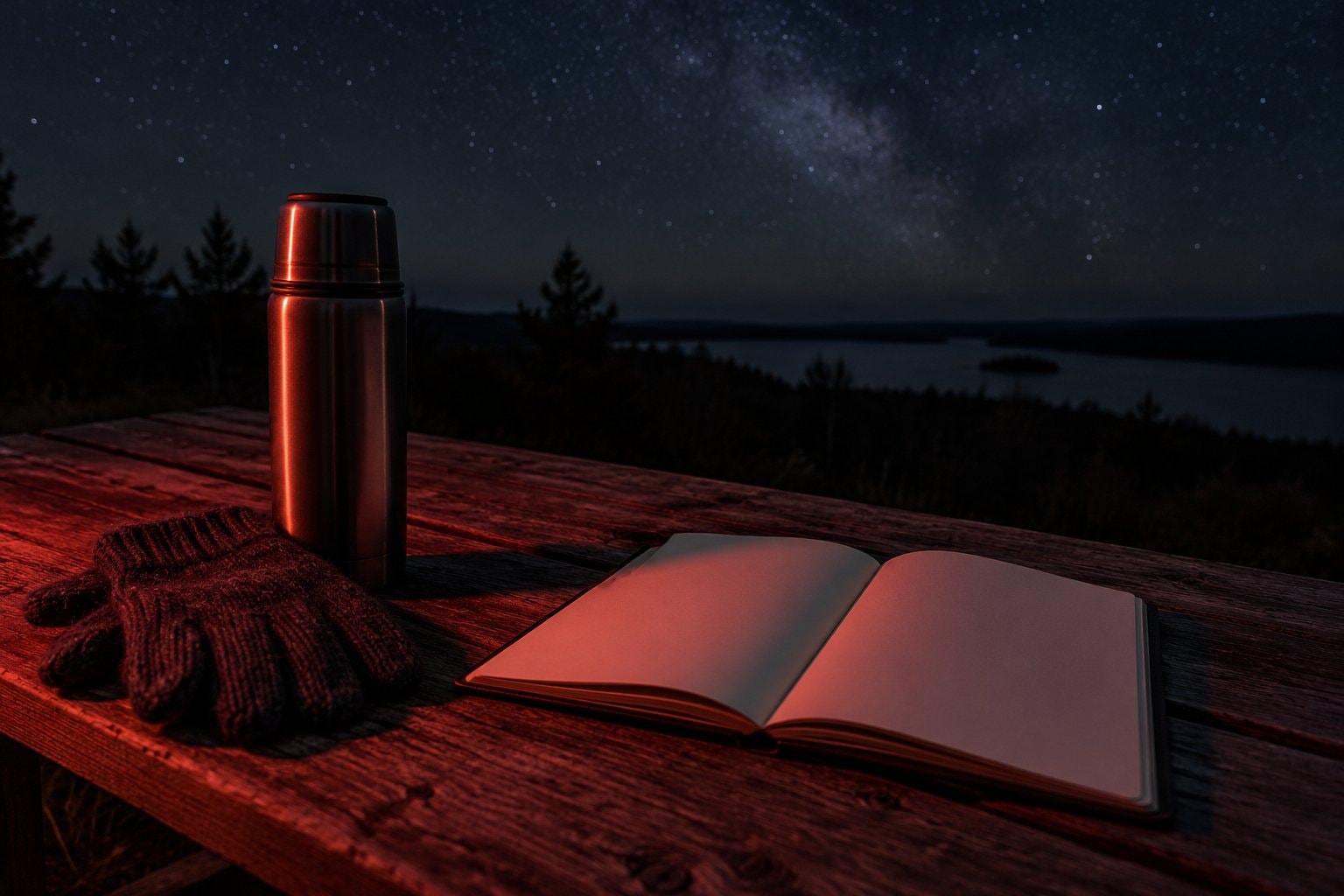
An observing night involves more than a telescope. Your eyes adjust to a dim view, your body spends time outdoors and the equipment has to be carried, arranged and put away. A faint target can encourage patient looking, but it can also make the cold or the late hour easy to overlook. Treat light, warmth, comfortable positioning and a sensible finish as ordinary parts of the plan. This is general information, not medical advice.
The eye at the eyepiece
The National Eye Institute's explanation of the eye describes light passing through the cornea, pupil and lens to the retina, where photoreceptors turn it into electrical signals carried toward the brain. An eyepiece presents an optical image, but seeing still depends on that biological process. A view that looks obvious in a bright room may be harder to interpret under a dark sky. Familiarity with the target and patience at the eyepiece matter alongside the equipment.
Wikipedia's rod-cell article describes rods as more sensitive in low light than cones, with little role in colour vision, and identifies rhodopsin as their light-sensitive pigment. This helps explain why a faint nebula may appear as a pale glow instead of the colour-rich picture associated with it. A visual impression is worth describing on its own terms. The deep-sky page distinguishes an eyepiece view from long-exposure photographs without making either a promise of what every observer will see.
Adjustment takes time
Wikipedia's eye-adaptation account gives approximately 20–30 minutes for adjustment from bright sunlight to complete darkness, while also describing longer times for rods to reach their maximum sensitivity. Those statements describe a gradual process rather than a personal timetable. The conditions before you went outside matter, and an unexpected bright light changes the situation again. Let looking become a patient activity rather than repeatedly checking a bright screen for the next target.
Lamb and Pugh's 2004 review examined dark adaptation and the regeneration of rhodopsin, describing a return of sensitivity after intense illumination that can take tens of minutes and noting that the slowness was still not fully understood. The review concerns biochemical and physical processes, rather than an observing routine. Its scope is useful background for understanding why a wider pupil alone does not explain the whole change. It does not supply a way to hurry the process outdoors.
Use the waiting period to become familiar with the sky around your target. Check the broad star pattern, settle the equipment and read the chart with a dim light. The beginner page starts with these simple habits. Do not judge a faint object only from the immediate view after stepping outside from a brightly lit room. A brief uncertain glimpse and a confidently repeated view are different observations, and a note can preserve that difference.
Looking beside a faint glow
Wikipedia's averted-vision article describes looking slightly to the side of a faint object while continuing to pay attention to it, and cautions that few rigorous studies have quantified the effect. This is a practical observing technique, not an eye exercise. Try describing whether a glow becomes easier to notice when it falls away from the centre of your gaze. An uncertain glimpse can remain uncertain.
Keep the target identified by its surroundings. If attention drifts, use the charted stars to check that you are still examining the intended part of the field. A faint patch that appears only briefly can remain a tentative note. Looking carefully includes recognising when the evidence is insufficient. An honest description of what was and was not seen makes the next attempt more understandable.
A dim red light
Wikipedia's Purkinje-effect article explains that relative sensitivity shifts toward shorter wavelengths as light levels fall, so reds appear darker relative to other colours. It also connects rods' low sensitivity to long-wavelength red light with the use of red illumination in naked-eye astronomy. Colour and brightness are therefore separate considerations. A red light still needs to be dim enough for the task, and should point toward the chart rather than across the observing space.
Keep the arrangement simple. Place the chart and notebook where you can find them without sweeping a beam around the telescope. Know where caps and accessories are before the view becomes dark. Practical organisation lets you spend attention on the sky instead of searching for a dropped part. There is no reason for the reading light to become the brightest feature of the evening.
Age and individual differences
Jackson and colleagues' 1999 study measured dark adaptation in 94 adults from their 20s to their 80s and reported slowing of rod-mediated adaptation with age, with the caveat that these changes may contribute to night-vision difficulties in older people. This is a report about measurements under study conditions. It does not predict the waiting time or experience of an individual observer at a telescope. Comparing yourself with someone else's quick description of a target is therefore an uncertain test.
Give your observation its own context: the lighting beforehand, the sky background, the instrument and what you could establish in the view. Avoid treating a difficult faint target as a measure of personal success. A simple bright target can still give a worthwhile evening. Any concern about a change in your vision belongs with a health care provider, rather than an explanation inferred from a star field.
The Sun demands a different approach
Under NASA's eclipse-safety guidance, never look at the Sun through binoculars, a telescope, a camera or a phone unless a proper solar filter made for that purpose covers the front of the instrument, and never look directly with the naked eye except through eclipse glasses or viewers meeting the safety standard NASA describes. Night observing habits do not make solar viewing a casual extension of the same task. The Sun-observing page explains the distinction between instruments and direct-viewing protection.
Ricks and colleagues' 2018 Utah case series after the 2017 eclipse reported twenty-seven patients concerned about vision changes, six with examination findings consistent with damage to the retina, and records available for three of those cases. The available records had central visual disturbance with corresponding retinal changes, as the abstract reports. These categories must remain separate: a concern about vision changes is not the same thing as an examination finding or a case with available records.
Poremba and colleagues' 2026 report around the April 2024 eclipse counted 1,774 emergency visits for eye injuries, with 853 before and 921 after, and found no statistically significant difference between the periods. The authors suggest that public education may have mattered, but this observation is not a direct test of educational success. Different study designs answer different questions. An absence of a statistically significant difference in these visits does not establish that unfiltered viewing is safe.
Laser pointers are not toys
Wikipedia's laser-pointer article describes their use in pointing out stars and hazards to eyes and aircraft; never point a laser pointer at a person, an animal, a vehicle or an aircraft. A chart and a spoken route through bright stars can explain a direction without a beam. The convenience of pointing does not remove the need to think about other people and traffic. A pointer is not required equipment for learning the sky.
Birtel and colleagues' 2017 review identified 48 publications describing 111 patients with documented acute and permanent damage associated with laser pointers. The authors describe the possibility of persistent retinal damage and visual impairment. These reports concern documented injuries. Keep the hazard distinct from the observing task, and do not use apparent beam brightness as a reason to dismiss it.
Cold nights and wind
The National Weather Service's wind-chill explanation describes how wind increases heat loss from exposed skin in cold conditions. The thermometer alone does not describe standing outside. Dress warmly, keep dry clothing available and leave room in the plan for breaks or an early finish. The sky does not need to be exhausted before an observing session can be complete.
MedlinePlus describes frostbite as involving skin that may become white or greyish-yellow, firm or waxy, and numb, with symptoms requiring medical care. Its hypothermia account describes abnormally low body temperature and warns that sleepiness, confusion or clumsiness can accompany it. Cold can change the way an evening feels and how well you manage its practical tasks. Do not treat a clear view as a reason to disregard those changes.
Carrying gear and reaching the eyepiece
NIAMS describes back pain as sometimes beginning after a fall or heavy lifting, and notes that pain can increase with lifting and bending. Heavy gear and awkward eyepiece positions are ordinary reasons to think through the setup before darkness. Carry equipment in manageable pieces, set the eyepiece at a comfortable height and take breaks. These are choices about the practical arrangement of observing, without a promise about a medical outcome.
Keep the walking route clear during setup and packing. A position comfortable for aiming may become awkward once the target moves, so allow space to change your stance without leaning across equipment. There is no obligation to continue a difficult view because the telescope is already assembled. Finishing while you can still handle the parts calmly is part of the plan.
A late night needs an ending
NHLBI's sleep-deficiency overview explains that inadequate sleep can interfere with focusing, reacting and driving. An interesting sky does not remove the following day's need for rest or the practical demands of getting home. Decide what a manageable finish looks like before a tempting target appears. Leave room for dismantling and packing rather than counting the final look as the end of the evening.
A sudden change in vision, eye pain after looking toward the Sun or a laser, numb or discoloured skin after a cold night, or back pain that does not settle are reasons to see a health care provider. A general observing guide cannot assess those symptoms. Rest, warmth and comfortable equipment handling belong to ordinary planning; questions about your health need individual care.