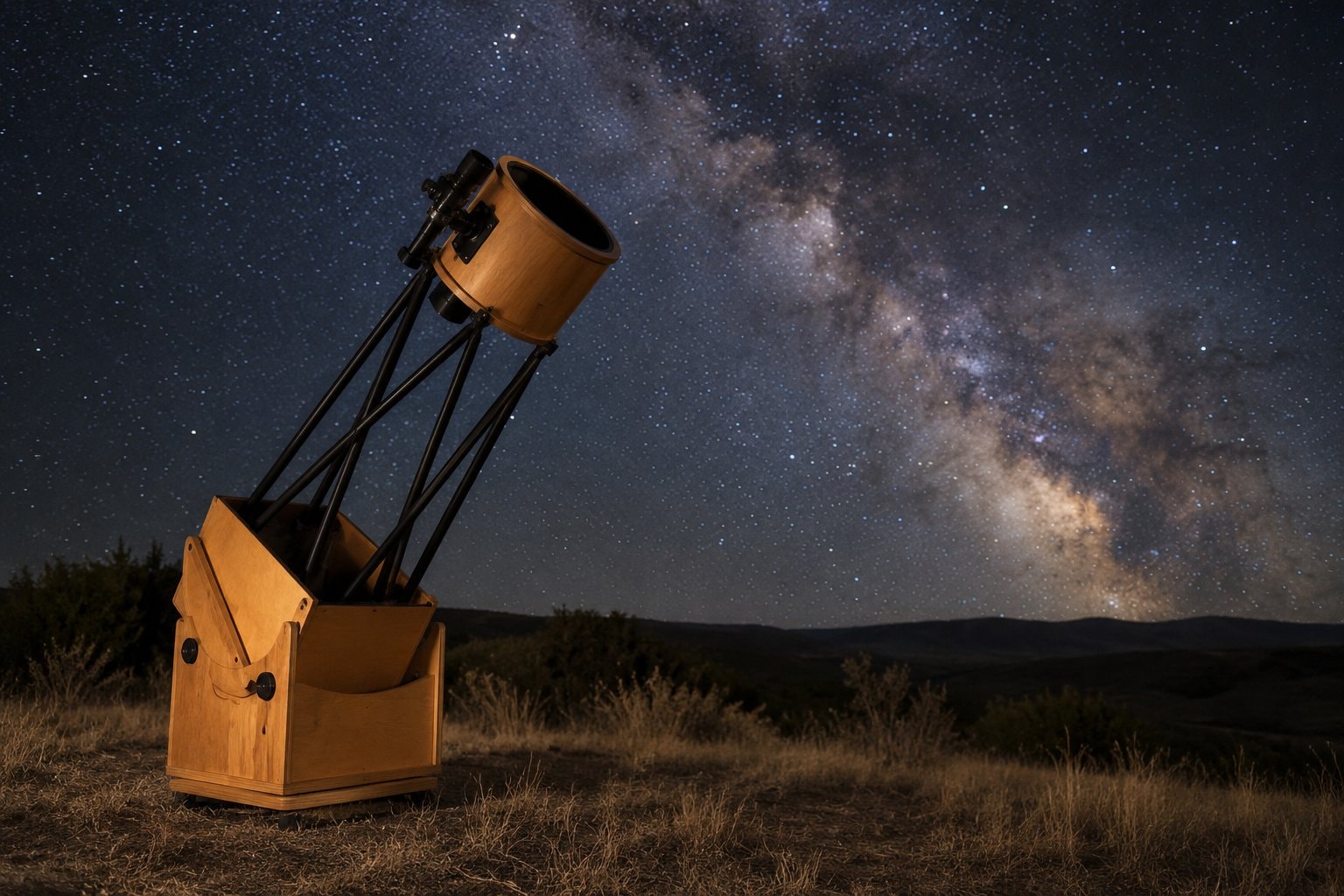
A telescope is an arrangement of optics and support, not simply a tube that makes things look larger. Its light-gathering element forms an image, the eyepiece presents that image to the eye, and the mount allows the view to be aimed and held. Understanding those jobs makes the different designs less mysterious. It also helps explain why a useful observing setup depends on steadiness, handling and the intended subject as well as on the size of the instrument.
Aperture and the light-gathering job
Wikipedia's telescope article explains that a larger aperture collects more light and permits finer angular resolution. In an optical telescope, aperture describes the light-gathering opening associated with its main lens or mirror. That principle is different from magnification: changing the eyepiece changes the scale of the view, while the main optics remain the same. Keep the distinction in mind when reading a description of a telescope. A magnification claim by itself leaves out an important part of how the instrument works.
Aperture is useful information, but it does not describe the entire experience. A large instrument may require more carrying, more space and a support arrangement that needs attention before looking begins. A modest instrument can be easier to put into use on an ordinary evening. These practical differences belong in the comparison rather than being treated as minor details. Think about a clear path outdoors, the place where the instrument will stand and how the eyepiece can be reached comfortably as the telescope points in different directions.
Refractors: light through a lens
Wikipedia's refracting-telescope article describes a front lens that forms the image, with the view brought to focus toward the rear of the tube. It also explains chromatic aberration, the colour error that occurs when different colours do not come to the same focus. Achromatic and apochromatic lens arrangements address that issue in different ways. The terms describe optical construction rather than a brand or a general guarantee of quality. They help a reader understand why superficially similar tubes can contain different lens designs.
For the observer, the rear viewing position is part of the arrangement to consider. Ask how it works with the mount when the telescope points high or low and how much room the tube needs to move. A refractor's main optical path is easy to picture: light enters through the front lens and travels toward the viewing end. That simple outline is enough for a first comparison. Detailed lens terminology becomes useful later, when it answers a specific question about colour, focus or the handling of the instrument.
Reflectors: light from a mirror
Wikipedia's reflector article describes Isaac Newton's reflecting design and explains how a Newtonian uses a main curved mirror and a secondary mirror to direct the image to the side of the tube. A mirror gathers the light instead of a front objective lens. The viewing position is therefore different from that of a typical refractor. Reflectors also have their own optical trade-offs, even though mirrors avoid the lens-related colour error. The word reflector is a broad design family, not a single telescope layout.
A Newtonian's side eyepiece is worth considering as a practical feature. The place your eye needs to reach depends on where the tube points and on how the tube is supported. Before treating aperture as the deciding detail, consider how the telescope will move and where the observer will stand or sit. A clear, steady view is easier to study when the body is not awkwardly stretched around the equipment. This is a question about using the arrangement comfortably, rather than a reason to assume that a design suits every reader.
Catadioptrics: lenses and mirrors together
The Schmidt–Cassegrain article in Wikipedia describes a catadioptric design combining a reflecting light path with a corrector plate to make a compact instrument. Catadioptric means that lenses and mirrors work together. In this design the image is delivered behind the main mirror, and the folded optical path keeps the tube relatively short. Compact tube length can be useful when space and handling matter, although the tube is still only part of the complete equipment. The mount and accessories have to be considered alongside it.
Optical length and physical tube length are not interchangeable descriptions. A folded light path can have a different relationship between them from a straight-through arrangement. That matters when thinking about field of view and the eyepiece, rather than simply comparing the outside dimensions of tubes. The astrophotography guide explains why an instrument's light path and tracking arrangement become significant when a camera is used. For visual observing, begin with the handling, the intended subjects and the view that can be kept steady.
The Dobsonian: a reflector with simple support
Wikipedia's Dobsonian article describes a Newtonian reflector on an altazimuth mount, a combination popularised by John Dobson and shaped around portable deep-sky observing. The name refers to the overall arrangement rather than a separate way for the mirror to form an image. A simple rocker-style support lets the telescope move upward and sideways. The approach brings the optics and the mechanical support into the same practical discussion. A large mirror still needs an arrangement that can be carried, positioned and moved smoothly.
With a manually moved arrangement, keeping the target in view is part of the observing task. The same article notes that undriven altazimuth telescopes need repeated nudges as the sky appears to move. That is a handling trade-off to understand before expecting the target to remain centred without attention. Smooth movement matters because an abrupt push can send the view away from the intended position. A broad starting view and a familiar chart can make that process easier to follow while the observer learns the instrument.
Mounts: where steadiness and tracking meet
Wikipedia's altazimuth-mount article explains the separate movements in altitude and azimuth: upward or downward, and around the horizon. The arrangement is mechanically straightforward, but following a celestial target involves changes in both directions. A manual observer makes those adjustments; a driven arrangement handles them mechanically. Either way, the optical tube still needs a support that allows controlled movement. A mount that shakes whenever it is touched makes it difficult to decide whether the detail in the eyepiece is in focus.
Wikipedia's equatorial-mount article describes an axis aligned parallel to Earth's rotation axis so that following the sky's motion can be done by rotating that axis at a steady rate. The alignment is part of the setup, not merely another name for moving upward and sideways. Such mounts are used with telescopes and cameras, and the article explains their value for keeping a target fixed in the instrument's view. Understanding that purpose is more useful than treating a complicated-looking mount as automatically preferable. The task determines which movements matter.
Eyepieces: scale, field and a comfortable view
Wikipedia's eyepiece article explains that the objective forms an image and the eyepiece magnifies it; the focal lengths of the telescope and eyepiece together determine magnification. Eyepieces also differ in field of view and eye relief. Eye relief concerns the position where the eye can receive the view, while field of view concerns how much of the scene is shown. Those terms help explain why a view can feel cramped or difficult to find even when the image seems large.
Start an unfamiliar target with a view that is straightforward to locate and hold. Centre it, bring it into focus and let the equipment settle before deciding whether a different scale would help. Greater apparent size is not a substitute for a steady image or a known position. The glossary gives short explanations of aperture, focal length, magnification and mount terms. Reading those definitions alongside a real setup helps keep the different parts of the telescope from becoming a confusing list of specifications.
Comparing the arrangements
| Design | How it gathers light | Typical strengths | Trade-offs |
|---|---|---|---|
| Refractor | Front objective lens | Direct optical path and rear viewing position | Lens colour correction and room for the tube |
| Reflector | Curved main mirror | Mirror-based light gathering and varied layouts | Viewing position depends on the optical arrangement |
| Schmidt–Cassegrain | Mirrors with a corrector plate | Folded path in a compact tube | Tube size alone does not describe the optical view |
| Dobsonian | Newtonian mirror arrangement | Simple support suited to visual deep-sky work | Manual movement needs attention to keep a target centred |
The table describes families rather than ranking products. A useful comparison includes the optics, the mount, the observing position and the effort of putting everything into use. For a first evening, the getting-started guide offers a simpler route through the sky before detailed equipment choices. A telescope can then answer an established question instead of becoming a new collection of unexplained parts.