The history of amateur astronomy is partly a history of attention: looking carefully, recording differences and learning how an instrument changes the view. It is also a history of practical work. A telescope needs an optical surface, a stable support and a way to point it. The hobby connects those workshop questions with the wider scientific question of what the sky contains. Its story includes both technical inventions and ways of sharing experience.
Lenses turned toward the sky
Wikipedia's history of the telescope places the earliest recorded telescope patent application in 1608, submitted in the Netherlands by eyeglass maker Hans Lippershey. The article describes early refractors as using an objective lens and an eyepiece lens. A familiar optical material could therefore reveal a distant view in an unfamiliar way. That does not mean the earliest instruments were straightforward to use or free of optical limitations.
The distinction between an invention and its use matters. A device can exist before people understand what questions it can answer. Pointing a magnifying instrument at the sky also asks something of the observer: recognising what is new, checking it again and separating a real feature from a fault in the view. Those habits remain useful with a small telescope today. The telescope-design guide explains the lens and mirror principles without assuming that magnification alone defines an instrument.
Moving points beside Jupiter
Wikipedia's account of the Galilean moons says that Galileo Galilei recognised the bright companions of Jupiter as its satellites in March 1610. Their movement made a powerful contrast with the idea that everything in the sky orbited Earth. The important evidence was not simply the presence of small points near a planet; it was the interpretation of their changing positions.
For an amateur observer, the example shows why returning to a target can matter. A sketch of positions gives another evening's view something to be compared with. An isolated impression is less able to show change. This does not turn every casual observation into a historical discovery, but it explains the value of patient, repeatable looking. Instruments reveal a view; records help an observer reason about it.
Making an image with a mirror
Wikipedia's reflecting-telescope article describes Isaac Newton's 1668 instrument as using a curved metal primary mirror and a small diagonal mirror that sent light toward a side-mounted eyepiece. The optical work was done by reflection rather than by a large front lens. The arrangement became the basis of the Newtonian reflector. It remains easy to recognise the broad idea even when the materials and construction differ.
A mirror is an optical surface as well as a physical object. Its shape determines how returning light comes together, while its support must hold it without distorting the intended form. Wikipedia's reflector article also describes the difficulty of early metal mirrors, including tarnishing and repeated polishing. The history is therefore more than a sequence of clever layouts. It includes the problem of making a useful surface and keeping it useful.
A comet hunter's unwanted glows
Wikipedia's Charles Messier article explains that his work as a comet hunter repeatedly brought him across fixed diffuse objects that could be mistaken for comets, prompting a list to avoid the confusion. Objects that interrupted a search acquired a different value when organised into a catalogue. Their steadiness was part of what made them useful reference points rather than new discoveries of a passing comet.
The Messier-list page discusses how that catalogue now helps organise observing. It offers variety without requiring a beginner to choose from the whole sky at once. The historical purpose also supplies a useful reminder: the reason an object enters a list is not necessarily the reason someone observes it today. A practical sorting tool can become a route into questions about clusters, nebulae and galaxies.
The workshop as part of the hobby
Wikipedia's amateur-telescope-making article describes hobbyists building instruments for the technical challenge, personal use or research, with Newtonian primary mirrors ground, polished and carefully shaped. Making a telescope brings the optical and mechanical questions into direct contact. The mirror must form an image, the support must hold it and the mount must let the observer follow a target. Success in one part does not automatically settle the others.
The mirror-making account describes work progressing from a flat glass disc through grinding and polishing toward the required optical form. This is a process of checking as well as shaping. The desired surface is not established by appearance alone. A builder needs a way to compare the work with the intended result. That combination of patient making and patient measurement gives telescope construction its own interest within amateur astronomy.
Porter and a shared craft
Wikipedia's account of Russell W. Porter describes him as an artist, engineer and amateur astronomer associated with the growth of amateur telescope making. Those roles help explain why clear drawings and practical construction can belong to the same story. A difficult instrument is easier to understand when its parts and light path can be pictured. Communicating a design is part of making it available to other people.
Stellafane's own early-history account says the Springfield Telescope Makers were founded in 1923, with roots in a telescope-making class offered by Porter in 1920. Wikipedia's Stellafane article likewise traces the group to his instructional class and describes its convention as a meeting of telescope makers. A craft practised together allows ideas, difficulties and test results to be discussed. The point is the exchange of practical knowledge, not only the finished instrument.
Print and organised observing
Wikipedia's account of Sky & Telescope describes a magazine for the informed general reader, covering observing, telescope making and astrophotography, with its first issue published in November 1941. A shared publication gave geographically separated readers common subjects to consider. Charts, explanations and technical discussions could connect work done at individual eyepieces and benches. The history of the hobby includes these ways of carrying knowledge between observers.
Wikipedia's Astronomical League history traces its formation from meetings beginning in 1939 to adoption of its name and bylaws in 1947. Its wider description emphasises education, communication and incentives for observation. Organised astronomy can therefore give a personal hobby shared methods and aims without making every observer's interest identical. The clubs page describes that variety in present-day terms.
A large mirror on a simple support
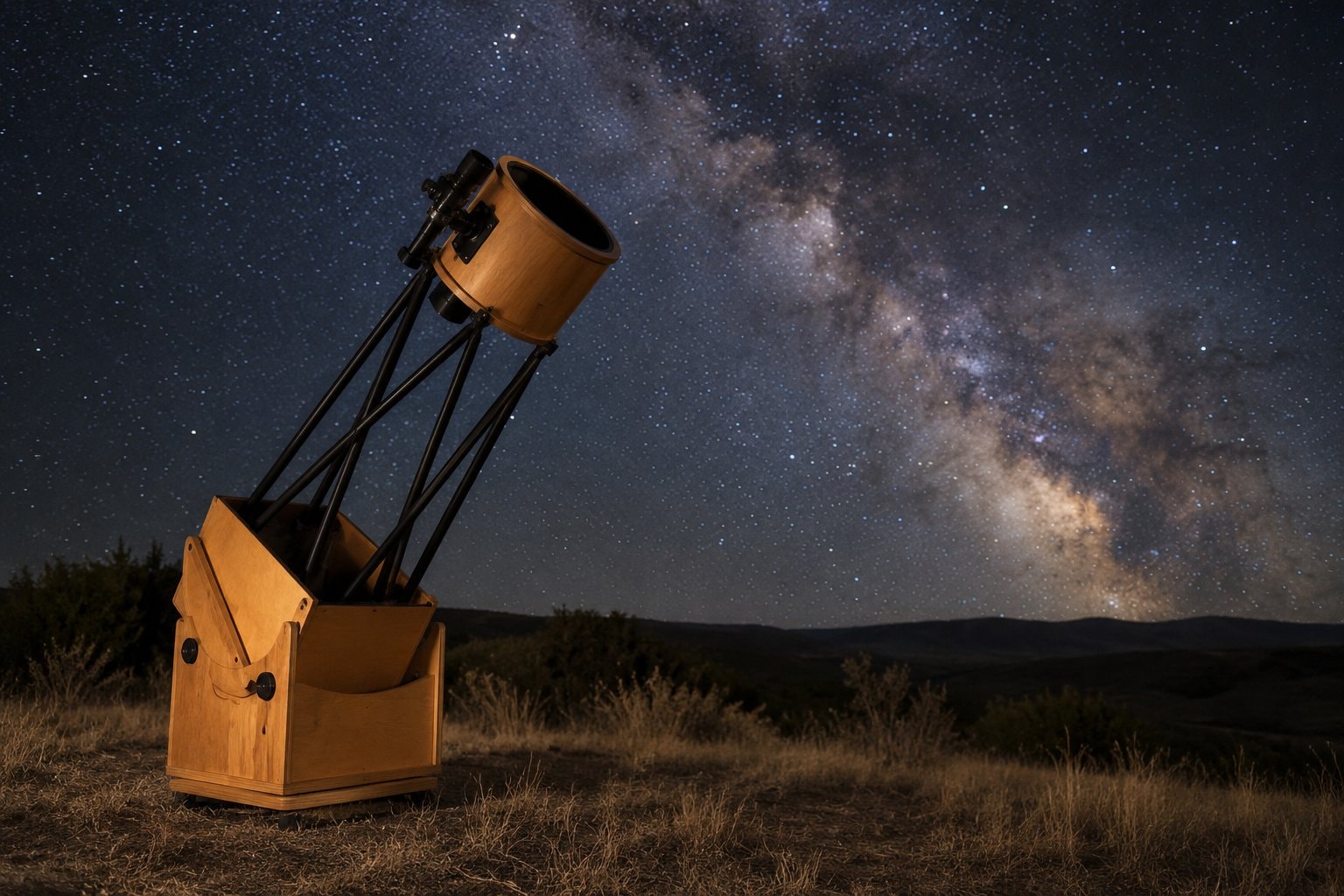
Wikipedia's Dobsonian article credits John Dobson with popularising the design in 1965 and describes a Newtonian telescope on a simplified altazimuth support. The combination put emphasis on aperture, portability and visual observing. It is a reminder that a familiar optical design can acquire a different practical role when its mount and construction change. The whole instrument matters, not just the name of the optics.
A simple movement up and down and around the horizon can make sense for visual work, while tracking photography asks different things of a mount. This is a trade-off rather than a ranking. Telescope history contains many responses to different tasks, and amateur practice still reflects that variety. An instrument intended for one kind of observing should be understood in that context.
A regional view of the wider story
Wikipedia's Yerkes Observatory article describes the Wisconsin institution and its great refractor, and identifies George Ellery Hale as a founder. Wikipedia's Adler Planetarium article identifies Max Adler as the founder of the Chicago astronomy museum. These institutions represent different ways of relating to the sky: astronomical instruments and public explanation. Their history is background to the region's interest in astronomy, not visiting information.
A backyard observer can recognise the enduring questions in these larger stories. What does the instrument reveal? How can the observation be checked? How is it recorded so someone else can understand it? The citizen-science page follows that last question into shared records of stars, meteors and sky brightness. The equipment has changed, but careful observation and a readable record still give the hobby its substance.