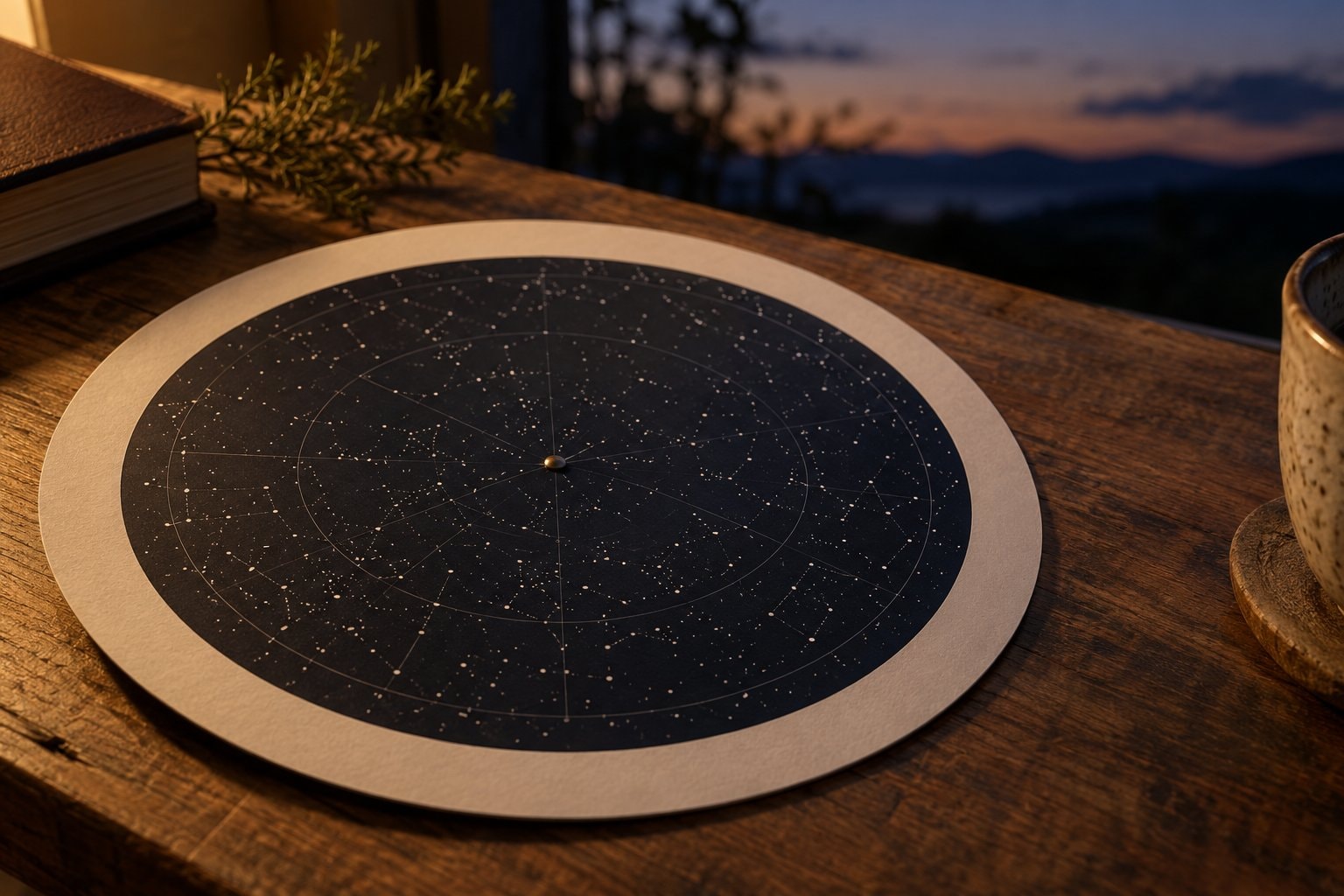
A star chart becomes useful when its dots can be connected to a view you partly recognise. Begin with the horizon, the direction you face and a bright shape that seems clear. The chart then gives that shape a place among the others. It is not necessary to learn every constellation before looking through binoculars or a telescope. A reliable starting point and a deliberate route can be enough to make a small part of the sky understandable.
Constellations are regions as well as patterns
Wikipedia's constellation article describes the modern list of 88 constellations and explains that their boundaries cover the whole sky. The familiar outline associated with a constellation is a useful visual clue, but the named region is more than the bright stars making that outline. This distinction explains why a faint object can be described as lying in a constellation even when it is far from the obvious figure. A chart shows the wider arrangement rather than only a connect-the-dots shape.
Learn a clear pattern before trying to read the entire page. Compare its broad outline with the sky, then notice nearby stars that make an easy addition to it. The aim is to recognise a real arrangement rather than to force every dot into a picture. Patterns also need room around them: a garden roof or a tree can hide part of a shape that is complete on the printed chart. Keep the difference between the map and the visible horizon in mind when a pattern seems incomplete.
Asterisms make practical signposts
Wikipedia's asterism article describes recognisable star patterns, including the Big Dipper and the Summer Triangle, that are distinct from officially bounded constellations. An asterism is therefore a useful shape rather than a separate officially bounded region. These broad, bright arrangements can make chart reading less abstract. Recognising a signpost gives you a starting direction, and the surrounding chart can then guide the search for something less conspicuous. The pattern's usefulness matters more than memorising a long list of names.
A shape on the sky is also a view from a particular position, not necessarily a group of stars that are physically close together. The same asterism article explains that apparent patterns need not represent a physical association. For finding your way, their appearance is enough. Notice which part is broad, which part narrows and which bright star provides the clearest anchor. A recognisable shape can survive a change in its tilt better than a memorised picture that assumes it always stands upright.
Set a planisphere for the view
Wikipedia's planisphere article explains a rotating star wheel whose window shows the sky for a chosen time, date and latitude. The visible pattern changes as the wheel is adjusted. A version suited to the observing latitude is therefore part of making the chart useful. Set it for the observing situation before comparing it with the real sky, and identify which part of the window represents the horizon toward which you face. The wheel gives a broad overview rather than a detailed close-up of a faint object.
The same article describes aligning the chart's eastern and western horizons with the real view. That matters because a flat chart is a representation of a sky that curves overhead. It can feel counterintuitive when held like an ordinary map in front of the body. Turn the chart to match the direction being examined, then check an obvious bright pattern before relying on the smaller details. If the pattern still seems wrong, check the chosen time, date and latitude before deciding that the stars are difficult to recognise.
Charts and atlases narrow the search
Wikipedia's star-chart article describes celestial maps that place stars, constellations and other astronomical objects on a grid, and distinguishes them from catalogues that list objects. That is a useful distinction for an observer: a name alone does not show the route to its position. A broad chart establishes the region, while a more detailed chart or atlas can supply the surrounding pattern needed for a closer search. Read the symbols and labels before expecting the page to explain itself in the dark.
Keep the chart scale separate from the optical field. A large area on a broad chart may be much wider than the part visible through an eyepiece. Begin with the sky pattern you know, locate the intended region on the page and then compare the smaller view with nearby charted stars. The binocular guide explains why a broad optical field can make that comparison easier. A telescope view usually benefits from the same habit of knowing where the search began rather than moving without a remembered starting point.
Follow a route, then check the result
Star-hopping is a practical way to turn a chart into a sequence of small, understood movements. Start from a recognisable star or shape, choose the next clear pattern in the intended direction and check that it appears where expected. Keep the route manageable. If the scene stops matching the chart, return to a known position and examine the mismatch. This is more informative than pushing farther in the same direction while the intended target becomes less certain. A search can teach the sky even when the object remains difficult.
A note can record the starting signpost, the direction taken and the pattern that confirmed the position. Leave uncertain identifications uncertain rather than assigning a name to a convenient glow. The glossary explains terms such as field of view, constellation and star-hopping that help make these notes precise. The getting-started page shows how a simple chart and a familiar subject fit into an observing evening without making the equipment or the target list unnecessarily complicated.
The map changes its place in the evening
Wikipedia's constellation article describes seasonal constellations and changing visibility from different places on Earth. A pattern familiar during an evening in a particular season need not be in the same position during another part of the year. The planisphere's changing view also makes the night's apparent turning easier to understand. Check the map for the actual observing situation rather than treating an earlier view as permanent. The year-in-the-sky guide connects those seasonal patterns with meteor showers and other subjects whose useful viewing conditions vary.