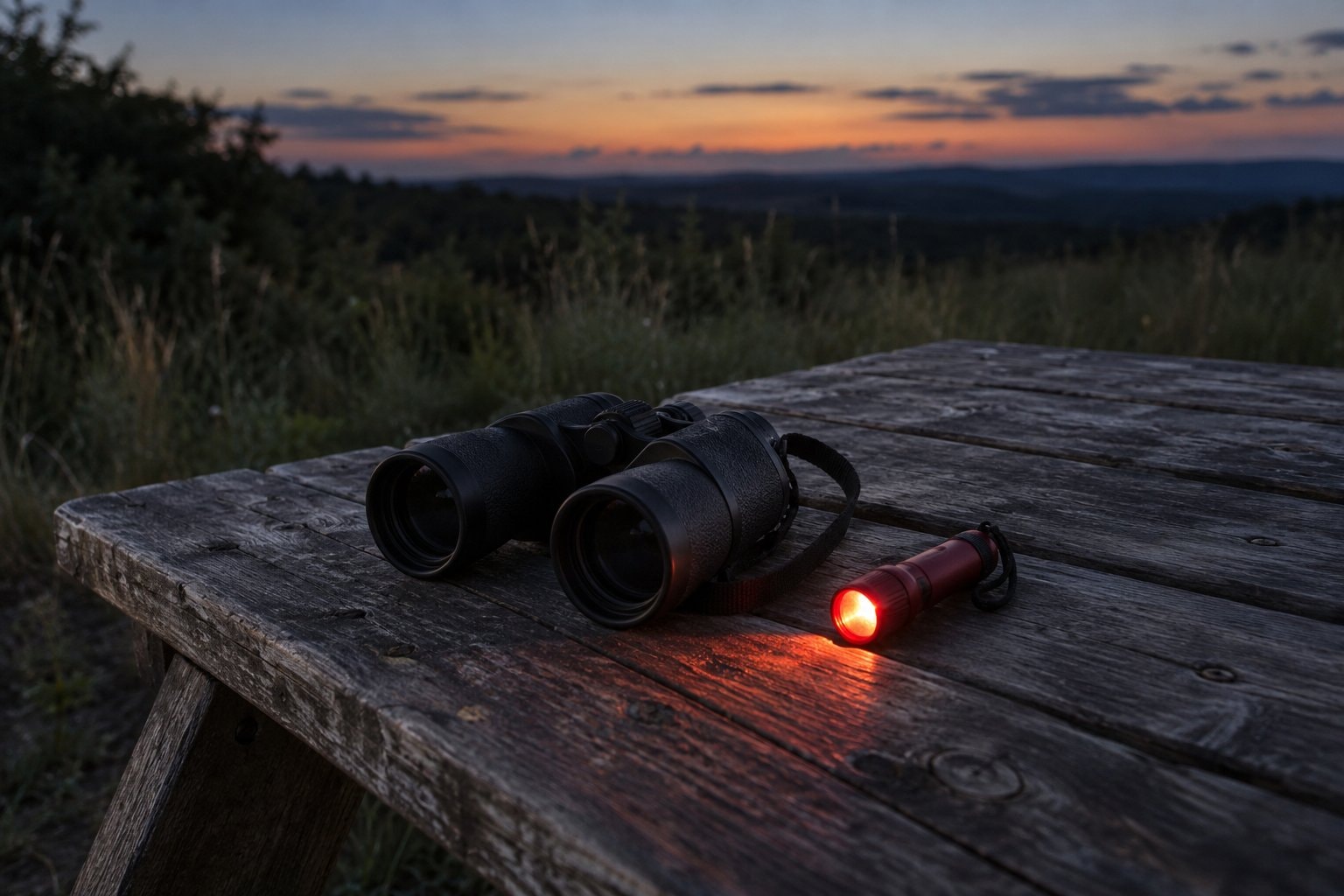
Binocular astronomy keeps the sky broad enough for surrounding stars to remain part of the view. Instead of treating each target as an isolated close-up, you can see its setting and follow the pattern that leads toward it. That makes binoculars a useful step between naked-eye observing and a telescope's narrower field. They still need careful focus and a steady hold. A view that moves around the sky is difficult to study even when the instrument makes stars easier to notice.
Read the description before judging the view
Wikipedia's binocular article explains that the first number in the usual description gives magnification, while the second gives the diameter of the front objective lenses, normally in millimetres. These describe different jobs: enlarging the apparent view and gathering light. The same article notes that higher magnification is more sensitive to hand movement and can require a tripod for stability. A specification therefore needs to be read as an arrangement of characteristics rather than as a simple score for the largest number.
In practice, begin with equipment that can be held or supported without a struggle. Settle into a comfortable position and notice whether the view becomes steadier when your arms rest. Focus on a clearly recognisable star before assessing a faint object. If the view remains difficult, separate the questions: whether the instrument is focused, whether it is moving and whether the intended object has actually been found. Changing everything together makes it harder to learn which adjustment helped the ordinary handling of the instrument.
Keep the chart and the sky connected
Find the broad starting pattern with your eyes before bringing the binoculars to it. Remember its place relative to the horizon and nearby bright stars, then compare the optical view with the chart. Wikipedia's asterism article explains that bright star patterns are useful for people learning the sky; the Big Dipper and the Summer Triangle are examples of such patterns. The chart-reading guide explains how a signpost can lead into a smaller field without turning the search into random sweeping.
Star-hopping means keeping track of the route as well as the destination. Move from a known star toward the next recognisable shape and check what has entered the view. If the intended pattern disappears, return to the starting point rather than assuming the faintest patch must be the target. A wide field can make that route easier to understand because several surrounding stars remain visible together. Taking your time with the route is part of the observation, especially when the subject itself is not immediately obvious.
The Moon: a familiar beginning
Wikipedia's Moon article describes dark plains known as maria and a surface marked by impact craters. These contrasting kinds of terrain give a binocular view something recognisable to explore without requiring a map of every feature. Look at the general outline, the larger light and dark areas and the changing edge of the lit surface. A stable view lets you compare those broad shapes rather than trying to resolve the smallest possible mark. The Moon guide explains phases and why changing illumination matters to the appearance of the surface.
Clusters within their surroundings
Wikipedia's Pleiades article describes an open star cluster in Taurus that is conspicuous to unaided eyes. A wide optical view can then be approached as a comparison between a familiar naked-eye pattern and the surrounding star field. Notice the shape, which stars stand out and how much room surrounds the main group in the view. Do not expect a visual scene to match a colourful long-exposure photograph. The value of the observation lies in understanding the pattern and its place in the sky.
Wikipedia's Double Cluster article describes neighbouring open clusters in Perseus that are visible to unaided eyes. For a binocular search, begin with a chart and a known nearby pattern so that the intended area is established before judging any crowded patch. Compare the separate concentrations of stars with their surroundings rather than trying to identify every point. The broad view is useful here because the setting is part of the subject. A modest description of a dense group and its position is more informative than claiming detail that the view did not show.
A nebula and a galaxy
Wikipedia's Orion Nebula article places this bright nebula below Orion's Belt and describes its fuzzy appearance through binoculars or a small telescope. Use the recognisable constellation to establish the direction before looking for the softer patch. A visual observation may begin with the difference between a sharp star and a less sharply defined glow. That distinction is enough to make the subject interesting. The deep-sky guide explains what separates nebulae, clusters and galaxies and why photographs present a different view.
Wikipedia's Andromeda Galaxy article states that it is visible to unaided eyes in dark skies. Binoculars can be used to explore the area, but a dim patch should be judged with the sky background and surrounding light in mind. Begin with its position among the chart's stars, then ask which part of the view is distinguishable from the background. Keep the description restrained. A faint oval or concentration of light can be a worthwhile observation without showing the sweeping detail familiar from photographs.
Record the useful part of the attempt
Simple notes can say which starting pattern led to the target, whether the view was steady and which shapes were clear. Note uncertainty as well as recognition. Returning to the same subject under different sky conditions gives that description a practical use. The getting-started guide places binoculars within a gradual approach to observing, with familiar subjects and manageable expectations. A well-understood wide view is a substantial part of the hobby, whether or not a telescope becomes the next step.